

.png?width=48&height=48&name=icons8-backend-development-96%20(1).png)
.png?width=48&height=48&name=icons8-omnichannel-96%20(1).png)


.webp)
Enrollment is the lifeblood of K-12 schools, networks, and districts. Without consistent enrollment, schools lose funding, staff stability, and long-term sustainability.
Yet many K-12 schools still manage enrollment with disconnected systems — spreadsheets, admissions tools, SIS platforms, email inboxes, and manual processes that don’t work together. They spend hours, days, weeks, even months sifting through spreadsheets and trying to contact every family they can, only to inevitably have interested families fall through the cracks.
HubSpot solves this by acting as a central enrollment and engagement platform for K–12 schools and charter networks.
Yeah, I know I know..."HubSpot isn't for education", "education isn't a business", "we don't do sales". But hear me out. After a decade building HubSpot specifically for student recruitment, hiring, and donor management for K-12 charter networks and schools, I can tell you — it works, it's effective, and you've probably only scratched the surface. This post is going to focus exclusively on student recruitment and enrollment.
Why HubSpot Works for K–12 Schools
HubSpot Solves Enrollment as a Lifecycle, Not a Moment
Enrollment is not a single action — it is a repeatable lifecycle that happens every year. Just as I referenced earlier, "we don't do sales", well — that's true. You don't. You don't have a single transaction. You're not trying to sell a simple purchase. You're selling a future. You're in a situation where you have to win the application, win the registration, win the enrollment, and win the first day of school.
Then once you've done that — well you have to win it again. You have to win the re-enrollment.
Your job is tough. And doing it with disperate systems, broken processes, and an unGodly amount of Google Sheets will not get it done — especially in a time where almost every school is missing their enrollment goals.
Families go through a long process to enroll with you. There are a lot of steps, there is a lot of time, and there are a lot of opportunities to fall off. They discover a school → submit an inquiry → register for an event → attend an event → apply → wait → finally hear back about their application → enroll (hopefully) → begin the registration process → wait → attend orientation → first day of school.
It's a pretty wild process, especially if you're missing opportunities to keep them warm and engaged throughout the process. The length of the process is also riddled with opportunities to change their mind. Their friend, their co-worker, their acquaintance at church, the person in front of them at Starbucks can derail an enrollment with a simple comment about a different school or a negative one about your school. It's extremely fragile. Getting the application is only the beginning. If you're not doing everything you can to not only get in front of families, but to engage with them, stay in front of them, provide value, and get them excited about your community; you're bound to lose.
HubSpot is designed to manage the entire journey for your families. For K–12 schools, this means:
- Attracting families and introducing your schools to them
-
Tracking families from first inquiry to enrollment
- Allowing families to convert through a quick apply form, event registration, or simple inquiry
-
Identifying when and where families disengage while surfacing this information faster so that they can be reengaged
-
Automating communication during long enrollment windows to keep them warm
- Integrate with your application system to manage applications, families, and data in HubSpot
-
Reducing surprise attrition with better data visibility
- Create visibility around marketing attribution, application status, family communication, event registration, event attendance, and more
HubSpot Centralizes Fragmented K–12 Data
Most K–12 organizations store data across a lot of tools including (but probably not limited to):
-
Admissions platforms
-
SIS systems
-
Google Forms and spreadsheets
-
Email inboxes
-
Campus-level tools
If you work at a school or network, you're probably used to using all these tools and more to just pull simple information. How many applications do you have for each school? How many of those families have been contacted in the last 2 weeks? How have they been contacted and by whom? Are you on track to reach your enrollment goals? What should you do more of from a marketing and advertising perspective in the final push?
Some of these questions are likely completely unknown to you or your have to pull multiple data points from multiple tools to get a good guess at them. It's unsustainable and ineffective.
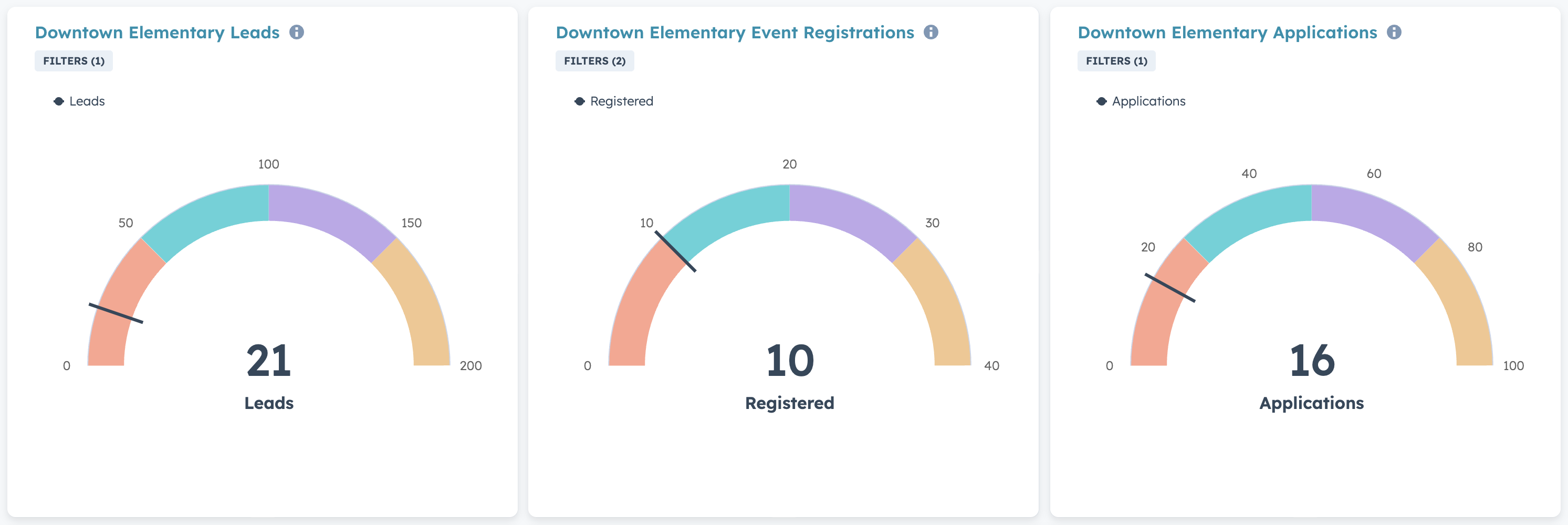
HubSpot connects these systems into one source of truth, allowing:
-
Campus-level visibility while allowing network-level oversight
-
Network-level reporting for leadership
-
Consistent enrollment processes across schools
- Up-to-date and accurate data to empower recruitment and enrollment teams (including application data)
- Marketing attribution reporting to understand what marketing and advertising campaigns are resulting in student
HubSpot Reduces Lost Inquiries and Manual Follow-Up
Networks and schools are historically and infamously understaffed. Your time, resources, and bandwidth are spread wildly thin so it leads to families that fall through the cracks and fall off the radar. It's just an ugly truth. Most networks rely on one or maybe a couple people to handle the follow up with families. It's too much for one person or a small team to handle, especially when it's done almost all manually. It results in:
-
Inquiries that never receive follow-up
-
Tour attendees who are never contacted again
- Feedback that falls on deaf ears
-
Applications that stall without engagement
- Families that disappear during the waiting period without any detail
That's where HubSpot comes in. HubSpot introduces automation throughout the entire process from the first inquiry to the application follow up that ensures:
-
Immediate responses to inquiries (and continued follow up if you don't get in contact with them)
-
Automated reminders for tours and deadlines
-
Re-engagement for incomplete applications, application updates, and internal notifications for families and applications that may be stalling out
-
Consistent communication across campuses internally and externally
- Marketing and engagement messages (text, email, and social media) to keep families engaged, warm, and focused on your school.
This improves enrollment outcomes without adding staff workload. As a school, you live a life of having to do more with less. You're great at finding ways to do that, but you're never going to be able to do all of these things effectively without a full automation platform like HubSpot.
Common K–12 Challenges that HubSpot Solves
Enrollment Challenges
-
Lost or untracked inquiries
-
No marketing visibility from inquiry to enrollment
-
Long gaps between application and enrollment decisions
-
Inconsistent experiences across campuses
HubSpot keeps families engaged during long enrollment windows so interest does not fade.
Operational Challenges
-
Staff manually moving data between systems
-
No reporting leadership can trust
-
Each campus using different processes
HubSpot standardizes enrollment operations while allowing campus-level flexibility.
Communication Challenges
-
One-off emails (every...single...time...)
-
No segmentation by grade, campus, or enrollment status
-
No automated reminders or follow-up
HubSpot enables targeted, automated communication at scale.
Marketing & Attribution Challenges
Most K–12 schools spend heavily on marketing but cannot answer:
What actually led to enrolled students?
HubSpot connects:
-
Marketing campaigns
-
Events and tours
-
Applications
-
Enrolled students
This gives schools true enrollment attribution and data-backed decision-making.
If you or your enrollment team would say:
-
“We track this in spreadsheets”
-
“We export from one system and upload to another”
-
“We don’t know where families drop off”
- "We don't know what marketing is really resulting in students so we just repeat our campaigns each year"
Then HubSpot is likely a strong fit.
Quick check:
If any of these challenges sound familiar, you don’t need another tool — you need a clearer enrollment system.
How HubSpot Should Be Set Up for K–12 Schools
Recommended HubSpot Object Structure (Charter & K–12 Networks)
Now like I mentioned, we've been through it when it comes to charter networks on HubSpot. We've seen just about every iteration of how HubSpot could be set up for a network. We've seen portals with no student data, we've seen portals mixing parent and student data as contacts, we've seen students as deals, and we've even seen (gulp) the worst one of all — families as companies. It's all been a mess. It's not scalable, it's not useful, and five minutes after you build it, it's broken.
So in our decade of work here, we have refined the proper set up and I assure you — it just works.
- Parents / Guardians → Contacts
Parents and guardians have to be contacts because the super power of this object is the ability to call, email, and text this record. With any K-12, you want your parents and guardians to be the one receiving your marketing communication. Pretty straight forward, but the key here is that students are not contacts. - Applications → Deals (and you should absolutely rename the object to "Applications")
This one is vital to the success of your enrollment strategy. Setting applications as deals allows you to utilize deal automation, sales triggers, reporting, and effective board views to manage your applications.
Taking this a step further, you can integrate your application system like SchoolMint or Avela into HubSpot to create those deals each time an application comes through and gets updated. - Students → Custom "Students" object
Here's where HubSpot has grown up a lot. The introduction of custom objects over the last few years has changed the game. Now, we can create a custom object for students to track student-specific data. Things like school, grade, date of birth, current school, etc. can all be tracked right there on the student record (and is reportable) and then you can also create super important associations with their parent/guardians, their application(s), schools, events, and yes — siblings.
One of the biggest issues that we've seen with networks is that they don't really capture student data in HubSpot. They focus solely on the parent because that is the person (or people) that you're reaching out to. But relying only on parents/guardians will inevitably skew your data. Think about it — you have a single mom who you're talking to about her four children. One of those kids is an enrolled student, two are prospective students, and one will be a preschooler in two years. What does your data say about them? You would probably see one lead (the mom). And that's it. Taking a step back and introducing the Students object, you can now report on the fact that you have one enrolled student, two prospective students (and the school(s) they're interested in), and also the fact that there is a fourth student coming soon. That is way more impactful data. - Schools / Campuses → Custom object
This is not necessarily for every build, but if you have a lot of schools and want to be able to manipulate your data at a school or campus level, creating and associating a custom object can be extremely effective for your data structure, modeling, reporting, and goals. - Events → Custom object
This one gets fun. Now we're taking things several steps further than the average build.
Events like tours, open houses, and shadow days are extremely important to your enrollment efforts. You have to be able to manage event creation, promotion, registrations, reminders, attendance, and follow up effectively or your enrollment cycle is going to go down the drain fast. So — you're probably using Eventbrite as everyone does.
The problem with that is that it's again another system to manage, pull data from, and try to piece together a story. And you can try to integrate it, but the integration data from Eventbrite is actually pretty messy (even if the app says it's easy).
So why not build your own? One of my favorite HubSpot builds that we've done is our event management system build out that allows schools to submit new events through a form that automatically creates a new event. That new event automatically pushes to the appropriate registration page where families can register for the event. And then when it's the day of the event, all of that information is indexed and you can search for the parent's name or email address to check them in.
Taking it further — you can then report on how many registrations does each event have, how many attendees did each event have, how many registrations does a school have across all of their events, how many attendees did each school have at all of their events. Pretty neat, huh?
It gets better — you can take it further to see which contacts attended each event and did they ultimately end up applying and/or enrolling with your school. BOOM. Event attribution tied directly to your outcomes of applications and enrollments.
Yeah, but who's done it?
Education is notorious for not wanting to be the first. There are no first movers or people that want to blaze a new trail that has never been done anymore. And it's for good reason — financial decisions have a big impact in your world. Making a bad decision wastes valuable and important budget. You simply can't make a big decision that you can't say with certainty that it's been done, done well, and succeeded for a peer.
Well, you're in luck. When we were helping to blaze this trail for charter networks over a decade ago with DSST Public Schools in Denver and Aurora, Colorado, we went through all the stages. We built, failed, built again, and optimized over and over and over again over years to finally get to a point where we feel like we have a solution that not only works for charter networks and K-12 organizations, but feels like it was made for it.
Fast forward a decade from our first foray into HubSpot for charters and we now have proudly worked with nearly a hundred organizations all across the nation from single site schools to multi-state networks with dozens of schools. And our process? Tried, true, and perfected. Check out a small sampling of our amazing K-12 clients and view more on our education page.









Plus — check out some of our amazing case studies from DSST Public Schools, Vista College Prep, Uplift Education, and Prospect Schools for more insights, approaches, and results.
So there you have it. After a decade, we've finally achieved a HubSpot build for education that not only doesn't suck, but it legitimately makes lives, jobs, and processes easier. It creates efficiencies, transparency, and communication that results in better data, better decisions, and ultimately more students.
Now, this isn't everything. There are plenty of other bells and whistles that we can get into when it comes to education — think donor management, hiring and people, re-enrollment, attrition and persistence, and the list goes on.
The best thing about HubSpot is that it's never done. It's never reached its limit. It's never not evolving. It's the CRM version of Legos. So what should we build next?
We’ve Built This System for Nearly 100 K–12 Organizations
Single-site schools. Multi-state charter networks. Enrollment teams stretched impossibly thin.
The HubSpot architecture described above isn’t theoretical — it’s the result of a decade of iteration, failure, rebuilding, and scale.
If you want:
-
A single source of truth for enrollment
-
Fewer lost inquiries
-
Clear attribution from marketing → enrollment
-
Less manual work for overstretched staff
- The best possible deal on HubSpot (yeah, we can negotiate to get you the best rate)
Then the next step is simple.


.webp?width=100&height=100&name=10%20Signs%20Your%20HubSpot%20Setup%20Is%20Failing%20(+%20Fixes).webp)