

.png?width=48&height=48&name=icons8-backend-development-96%20(1).png)
.png?width=48&height=48&name=icons8-omnichannel-96%20(1).png)


We are fresh off the heels of two conferences that we exhibited at and honestly — it was the same old thing from most of the sponsors. Boring layout, hungry sales people, terrible swag. This is why so many people walk the conference and do everything in their power to avoid eye contact.
But, we have actually seen success at conferences because of one simple thing — being human.
Humans want to receive before they give. It's really human nature. No one, and yes I mean absolutely no soul alive, wants to or likes to be sold. We do everything in our power to avoid it. And an exhibit showroom floor is like walking through a lion pack with a bag full of steaks.
But what if you changed your mindset? What if you gave before you received? What if you entertained? What if you engaged in a meaningful way that isn't salesy? Then what?
The Booths That Win Give Before They Get
Walk any trade show floor and you will see a predictable pattern.
-
Booths lined up shoulder to shoulder.
-
Sales reps standing at the edge of the carpet.
-
A bowl for business cards.
-
A QR code for a raffle.
-
A pitch that starts before the attendee finishes saying their name.
The strategy is almost always the same:
-
Capture the lead.
-
Scan the badge.
-
Justify the spend.
It is an extraction model and it is why most event marketing underperforms. It's all about the ROI. And I get that part. You have to justify the expense. But doing that by jumping at every single person that mistakenly makes eye contact is no way to do that.
At a conference, attention is scarce, skepticism is high, and every attendee has been conditioned to protect themselves from being sold. The booths that consistently outperform, the ones that generate real pipeline instead of a spreadsheet full of cold scans, operate differently.
They give before they get. Not as a gimmick. Not as manipulation. But as a deliberate strategic posture.
The Economics of Attention
An event compresses competition into a single physical space. And you're not just competing with a few vendors that do the same thing that you do. No, you're competing with everyone and everything in the building.
Every booth wants:
- Attention
- Time
- Conversation
- Data
Attendees want something else:
- Insight
- Novelty
- Help
- A break from being pitched
If your opening move is “Can we scan your badge?” you are asking them to assume risk. Risk of spam, risk of aggressive follow up, and risk of wasting time.
Most attendees respond rationally. They protect themselves. They disengage quickly. They give fake emails. They avoid eye contact.
Now flip the equation. Instead of asking for something, offer something meaningful first. No pressure. No condition. You then reduce risk, create goodwill, and even activate reciprocity.
And the dynamic changes instantly.
Why Most Booth Strategies Fail
Most event strategies are built backward. Companies ask, “How do we capture as many leads as possible?” which leads to predictable outcomes of:
- Cheap giveaways tied to form fills
- Generic swag with logos slapped on
- Scripted sales pitches
- Forced demo scheduling
The booth becomes transactional. Transactional experiences do not build trust. They build resistance.
A better question is: “What would make this the most valuable five minutes someone has all day?”
That question forces better decisions.
What Giving First Actually Looks Like
Giving is not about spending recklessly. It is about offering value people genuinely care about.
From our recent booth experiences, here is what moved the needle and why.
1. Give Insight, Not Just Information
At one event, instead of leading with a pitch, we led with a diagnostic tool called our Marketing Grader. Not a brochure. Not a “learn more” flyer. A real evaluation with real insight that even gave the recipient details on how to do better themselves — even without ever working with us.
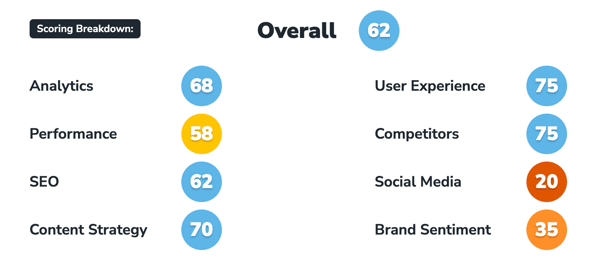
People are naturally curious about their own performance. They want to know:
- How does our marketing stack up?
- Where are we underperforming?
- What are we missing?
Insight is powerful because it is personal. When someone receives a score or assessment tied directly to their business, the conversation shifts from abstract selling to specific improvement. Instead of, “Let me tell you about our services.”, it becomes, "Here is where you are strong. Here is where you are leaking opportunity. Want to unpack it?”
That conversation is earned, not forced.
When someone sees real value before a pitch ever happens, trust accelerates.
2. Give Gravity Through Meaningful Giveaways
Most booths give away something worth 25 to 100 dollars in their drawings. If you're lucky, maybe a couple hundred bucks. That rarely creates momentum. It just isn't worth stopping.
At a conference last year, we wanted to try out a giveaway, but we wanted to go big. We wanted it to be something that people were excited about, would come back for, would show up at the drawing time, and even tell others about.
So we gave away an Apple Vision Pro.
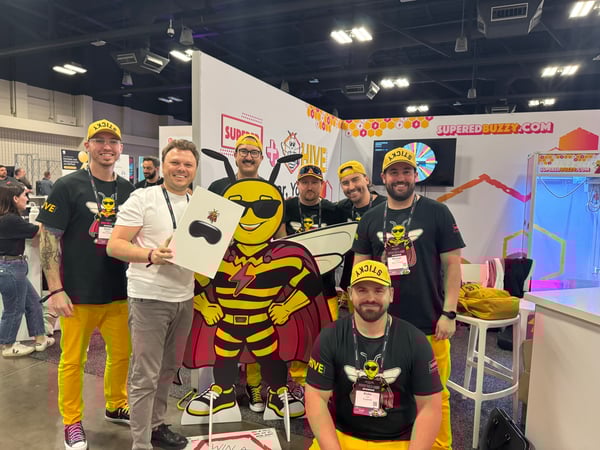
Not to be flashy for the sake of flash, but to create gravity around the giveaway. A meaningful prize creates gravity. A significant giveaway does three things:
- It increases booth traffic.
- It sparks conversation across the floor.
- It gets shared socially.
People bring colleagues over. They mention it in sessions. They post about it. The giveaway becomes a magnet.
But the prize only gets people to your booth. The experience determines whether they stay. If you rely solely on the prize, you generate a line, not loyalty.
The real work begins once they arrive.
3. Give Memorable Swag, Not Commodity Swag
Most event swag is invisible. Pens blend in. Notebooks get stacked in hotel rooms. Tote bags collect dust. And don't get me started on the stress balls and candy.
Commodity swag signals minimal effort. Most of it looks like you forgot that you should have some swag so you got the first thing you could get your hands on. Nobody remembers it. Nobody talks about it. And honestly, most of it is in the trash as soon as someone gets home.
We handed out stamped 2 dollar bills. It's really become our "thing" and people absolutely love it. Everyone has a story about a $2 bill.
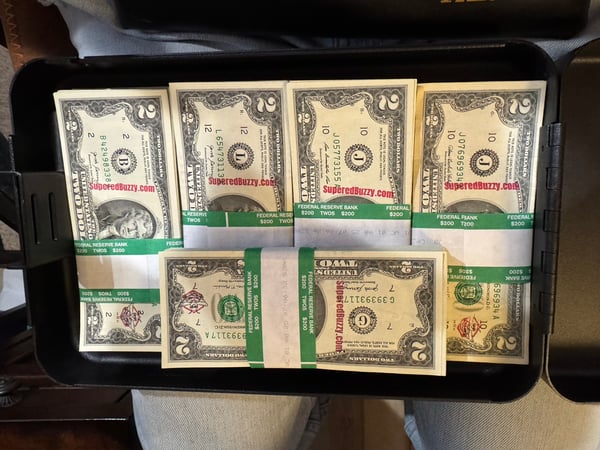
They are unusual.
They feel scarce.
They start conversations.
People pulled them out later in the day to show others. The purpose of swag is not utility, it's memorability. If someone remembers your booth a week later because of something distinctive you gave them, that is leverage.
Memorability compounds. Generic items disappear.
Now think of something cool for your booth, the $2 bills are our thing. Yeah, we saw that other agency taking our idea at another conference. The $2 bill thing is a HIVE thing. Just remember that. 😉
4. Give an Experience
The most crowded part of our booths was not the sign up table or the brochures. It was the activations.
We have done several activations at booths and they're always a hit. Give people something fun to do, see, or experience. It's meant to be an educational and fun time for them. Lean into that. Two of our favorites have been a claw machine (seriously people will try and try and try to get what they want) and our engraver. We bundled swag, $2 bills, stickers, and more in the claw machine and it was way more fun than just handing people their swag. They had a challenge, entertainment of watching their coworker play, and an experience.
With the engraver, we engraved custom keychains and mugs. We not only gave them a piece of swag with our logo on it, but we personalized it to make it mean something.
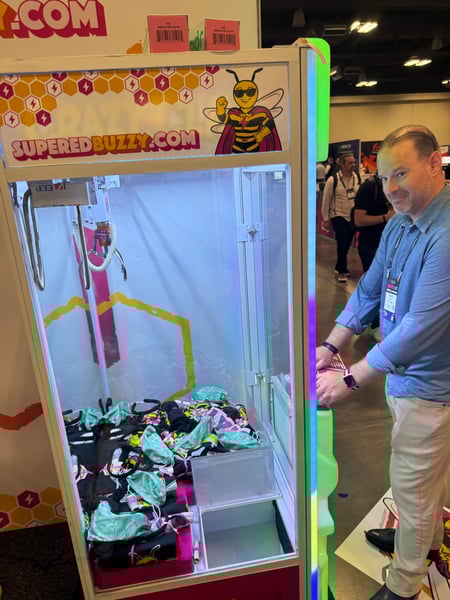
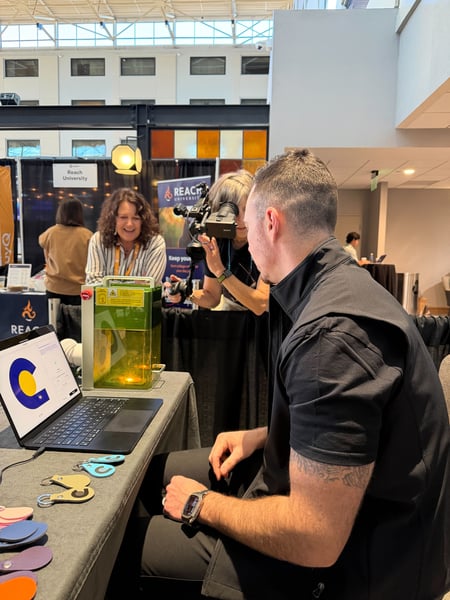
Why? Because experiences create emotion. Emotion creates memory. Memory drives recall. Recall drives opportunity.
When someone plays a claw machine or watches their name engraved on a tumbler, they are participating, not being pitched. They smile, they film it, they tag coworkers, they bring friends.
Your booth stops being a table with a banner and becomes a destination.
Destinations win attention.
The Psychology Behind Giving First
Three principles are at work when you give before you ask.
Reciprocity
Humans are wired to reciprocate value. When someone receives something meaningful such as insight, entertainment, or personalization, they naturally open up. They volunteer context, they ask questions, they lean into conversation.
Not because they were pressured, but because the exchange feels fair.
Signaling Confidence
When a brand gives freely, it communicates something powerful — We believe in our value.
Desperation repels. Confidence attracts.
A booth that immediately pushes for demos feels urgent. A booth that leads with generosity feels secure and security builds trust.
Lowered Guard
Events are saturated with selling. Attendees expect to be pitched. When you disrupt that expectation and offer something useful or fun without conditions, you lower defenses.
That is when authentic conversations happen.
Authentic conversations are where pipeline is born.
Measuring the Right Things
If your only success metric is number of leads scanned, you are optimizing for volume, not impact. Better questions would be:
- How many meaningful conversations did we have?
- How many attendees came back to the booth a second time?
- How many people mentioned us later in the event?
- How many follow up meetings felt invited instead of chased?
Not all scans are equal. A forced badge scan tied to a raffle is not the same as a conversation rooted in genuine interest.
Quality compounds. Volume without context decays.
The Long Term Brand Effect
Events are not just lead generation channels, they are brand amplification environments. When you give first, three long term effects occur:
- You become associated with generosity.
- You differentiate from transactional competitors.
- You build memory that outlasts the event itself.
Weeks later, when someone is evaluating vendors, the brand that felt different stands out. Not because of a logo, but because of how the interaction felt.
Emotionally differentiated brands win in crowded markets.
A Framework for Your Next Event
Before committing to another booth, pressure test your strategy.
Insight
Are you giving real knowledge or just marketing collateral?
Impact
Is your giveaway worth remembering or just compliant with expectations?
Identity
Does your swag reflect your brand personality, or could it belong to anyone?
Interaction
Is there something experiential that draws people in and creates energy?
Build a booth people want to visit, not one they feel obligated to tolerate.
Generosity Is a Competitive Advantage
At events, everyone is competing for attention. Few are competing on generosity. Giving first is not soft, it's not charitable. It's not naive.
It is strategic positioning.
The moment you stop trying to extract value and start creating it, you shift the power dynamic. You attract instead of chase. You engage instead of interrupt. You build trust instead of resistance.
In a room full of booths trying to take something, the one that gives the most value first is the one people remember when it is time to buy.
Now I didn't share all of this so that you can steal our ideas, but to inspire you to think outside the box. Think differently. Think about how you can engage in a giving first mindset with your audience. Regardless of whether it's a software conference, a marketing conference, an automotive conference, or an education conference (or something in between), it's a strategy that works every single time.
Be generous, create buzz, and have fun.


.webp?width=100&height=100&name=10%20Signs%20Your%20HubSpot%20Setup%20Is%20Failing%20(+%20Fixes).webp)